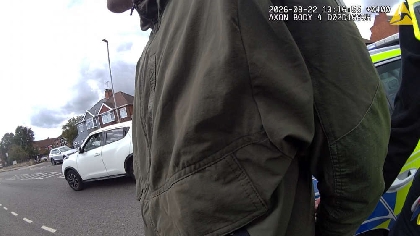


The army has been forced to stop a range of vital training, including live-fire tank exercises, because of a lack of money even as the government warns that the UK needs to be ready for war.
The decision - made with immediate effect - risks impacting the readiness of the whole force to be able to respond in a crisis.
It comes after the Kremlin warned it may attack British military targets because of UK support for Ukraine, and as Andy Burnham faces mounting pressure to commit to a faster increase in defence spending, such as by cutting the welfare budget.
Wes Streeting, the defence secretary, told Sky News in an interview for the new Defence Insider app that if reducing welfare spending to invest in defence were simple, then "bluntly" the government would have done so already as would the Conservatives when they were in power.
Reservists are also affected by the exercise squeeze, with some personnel seeing a reduction in how many days of training they will receive this year, Sky News understands.
Reserve forces - whose funding has for years been regarded as low-hanging fruit when defence is under pressure to find savings - are meant to be able to provide a critical element of additional mass and firepower should the nation be attacked.
That is only possible if they are properly trained and equipped.
The wider exercise freeze will not impact regular and reservist troops that are preparing for a deployment, such as to Estonia or the Falklands, it is understood. Units involved in a major NATO exercise next year are also not affected. The same is true for those who are in a quick-reaction or standby role.
For the wider force, however, the move means that, for the next few months at least, many full-time soldiers could be stuck in their barracks rather than honing their skills in the field.
A senior source said the real concern is the cumulative effect on the army.
Training is how commanders turn new equipment and concepts into fighting capability.
That means any decision to move money out of training their soldiers will inevitably start to affect readiness.
Read more:
Met Police chief 'flabbergasted' by release of gun crime suspects
Argentina's Javier Milei says 'we need to recover' Falklands
And the impact in some cases is irreversible, the source signalled, as soldiers could miss out on a key element of training that they do not have the chance to redo.
The ultimate risk is that the army is left with what is known as a hollow force.
This means on paper the Ministry of Defence has personnel and equipment, but unless people have had the chance to train on their kit properly, then they lack the collective experience and competence to be able to use it properly in war.
The Times and The Sun newspapers first reported the pause.
The Times quoted a senior military source as saying major war games involving 90 or more soldiers have been suspended under plans to save £30m.
Troops were told to "cease activity" after commanding officers received a directive to halt "collective training" unless their units were about to deploy.
Exercises with Challenger 2 tanks and Apache gunships are among those being cancelled as the army "pulls its armoured punch" and prioritises training troops in smaller-scale drone warfare.
A second source described the decision as "absolutely devastating". They told the newspaper: "Armies train, that is what they do. Now nothing is going to happen. Everything is cancelled and commanding officers have 600 blokes with nothing to do."
It is understood that commanders have had to prioritise the training that they do deliver because of a shortage of in-year cash for running costs.
They did not want to halt any training.
A rise in the price of fuel as well as higher costs for things like ammunition means that budgeting for routine exercises - that is often done years in advance - no longer adds up.
Matthew Savill, director of military sciences at the Royal United Services Institute (RUSI), said: "This is what happens when you are short on Resource money (RDEL, as it is known), which covers running costs, personnel, etc rather than new capability purchases (Capital - CDEL). The impact gets worse over time, because you might lose familiarity with equipment or tactics."
In a post on X, he added: "The fact this is happening now is worrying, and a sign of either the problems of 'annularity', or an indication that there are bigger problems inside defence (or both!). Annularity is the concept that the MOD has to manage its budget year to year.
"Other than in exceptional circumstances, it can't roll over money, and it absolutely can't spend more than is budgeted."
In a statement to The Times, the army said: "Through the defence investment plan, we recently announced £2bn to transform training … over the next 15 years. That investment makes it all the more important that we prioritise activity that contributes most directly to readiness, deployability and operational effectiveness. That training continues."
An Army spokesperson said on Friday: "Our training continues and we are prioritising activity that contributes most directly to readiness, deployability and operational effectiveness.
"We are also investing £2bn to transform training for the British Army over the next 15 years."

(c) Sky News 2026: Army stops some training exercises over lack of money despite Kremlin warning
 Boy dies after car hit by train on level crossing in Co Mayo
 HMRC threatened with legal action over Israeli settlement trade
 Police given 40 potential names for woman found at Liverpool park inside bin bag
 Met Police chief 'flabbergasted' by release of knife and gun crime suspects on bail