
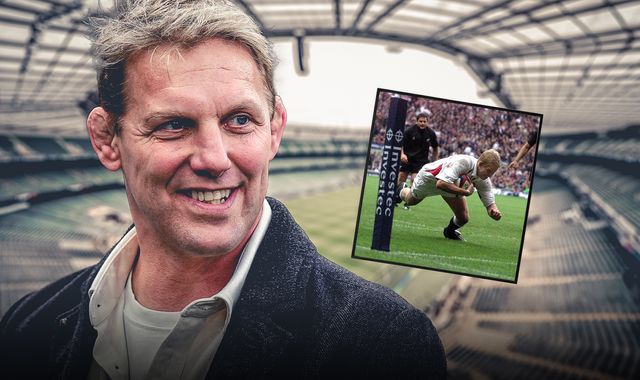
Winning used to be about coming first, but now it means something very different to Lewis Moody, writes Sky Sports' Gail Davis...
The overriding emotion as I left my conversation with Lewis Moody was one of awe. He is an undoubted superhuman. If I ever find myself in the depths of the adversity he now faces, I hope I have the strength to tackle it in the Moody way.
I watched him win rugby matches for Leicester and England, I saw him push himself to become the best in the world and a few hours in his company makes you realise despite being diagnosed with MND - a disease there is no cure for - he is still the same competitive animal.
- Lewis Moody: How he is hoping to have a big impact on MND
- What is MND and what are the links to sport?
- Support Lewis Moody's Cycle Challenge
- Find out more about MND
"Winning looks like having a wonderful purpose that I am utterly passionate about," says Moody, who retired from rugby in 2012.
"For the last 14 years you feel like you've not had a proper fight to get into. Like your teeth have been a little bit blunt. You're happily just getting on in Bradford-on-Avon but now all of a sudden you've got almost reinvigorated."
It's ignited something. The old Lewis. "We always have masks that we use and my sporting mask was one that allowed me to amplify uniquely in one specific area."
Eight months have passed since Moody was given his MND diagnosis. As he told the world the news there was such a rawness. He admits he was still in shock.
"I've actually questioned myself about was it the right thing to do because it was only two weeks after I found out. But I want to be the person that shares the information, I wanted to be in control of that and how I shared it."
As a 2003 Rugby World Cup winner, Moody was well versed in handling almost anything, but nothing could have prepared him for the weeks that followed.
"It's a huge realisation that the emotion, whenever I get emotional, is when I think about the support that people are giving.
"The love that I felt, that we felt. That's when I... even now," - he pauses for a moment, his eyes well up and he composes himself and continues - "if I talk about myself, I can talk quite frankly, quite pragmatically about it all but if I talk about... it always hits me again."
Another wave of emotion hits him before he adds: "It meant escaping the conversation of MND is difficult. Your first question to me is: 'How are you?' You can't imagine how many times I get asked that and the character that I am, I know that people are asking from a place of kindness and caring. It has been slightly overwhelming, I suppose."
'I remain positive and hopeful'
Back in October, Moody certainly had not begun to process what having MND meant. He still hasn't.
"You're given the diagnosis and it feels unbelievably negative, all the noise around it is negative, your thought process is negative - but actually when you sit down with other specialists you start realising that no one individual is obviously the same.
"No person's experience of it is the same. The time that progression takes is different for everyone. The symptoms, just everything is different. So the only certainty is that everything is uncertain. That's what I've learnt and I suppose maybe the same can be said for life in many respects."
His network of family and friends got him through those first few weeks. He shares how his former Leicester team-mate Leon Lloyd drove hours to see him and ended up arriving so late he slept on his drive until morning just to give him a hug and show Moody how much he meant to him.
The emotional support certainly helped but Moody quickly realised he needed guidance in cutting through the noise and to get going on the practicalities of living with MND.
"Just information like 'where do we go to find out what we're going to do next', 'how much money do you need to live with MND and all the challenges', 'who are the people you need to speak to'.
The practical stuff is one thing but nobody other than Moody himself can help with his mind and his outlook.
Over the past few months, he has reframed the narrative around what it means to have MND. Perhaps that is more powerful than any of the drugs - there are some available to slow the progression down - or alternative therapies including breathwork and yoga.
"I don't feel any different because I can do everything I want to still. So I don't dwell on the future.
"Not that those thoughts don't come into my mind. I just am really proud to be staying focused. Emotions are always under the surface because you know what a diagnosis like this means, right?
"I remain positive and hopeful. I just choose not to dwell on the negative. I don't see any benefit for it. It's not that I'm not sad or difficult thoughts don't enter my head. Of course they do, I sit with it briefly, I rationalise it quickly and I just move on.
"For me it's a choice. I can choose to sit in this for as long as I want, but it's not going to help me. Frankly, it's going to make my day miserable and I'm going to lose precious time I want to make the most of so there's no great science to it."
Is there anger?
"Let me dwell on that for a minute," Moody replies. "I don't think so. But whether it's anger or whether it's something else, it's frustration maybe.
"There are certainly times where you're like, f*** this, this is bulls**it. But only fleeting moments. I suppose I know it doesn't benefit me.
"Thinking of things like fair and unfair, it's not helpful to my mental state, to my ability to operate every day, to where I want to go and the things I want to do with the charity and stuff."
It was a weakness in Moody's shoulder that led him via various scans and tests to his diagnosis and although there are times when he does forget he has MND, there are constant lingering reminders.
"So the shoulder has become a little bit weaker since the initial diagnosis. There's always regression for me at the minute.
"The specialist told me when I first saw him that everything I can see looks slow, which is great. Speed is relative, I suppose, isn't it? But that's great. And for me, it's continued slow.
"But again I said I always focus on the things I can do rather than things that I can't. So, when I'm training now, if certain movements are tricky, then we just adapt the weight or we change the movement."
To look at him and talk to him, he is the same Moody who was playing rugby up until 2012.
Only when he paused the interview to go and get some gloves from the car does MND come into focus. In the last few weeks the muscle between the bones of his hand has begun to waste and the cold makes the pain worse.
He returns with an impressive pair of leather gloves picked up on a recent once-in-a-lifetime trip to the Super Bowl.
For an athlete who trained his body to do what it needed to, it must be a seismic shift to let go of control.
"When that happens I recognise very quickly. Figuring out how you mentally deal with each little change that you notice, that's the hardest bit.
"Normally, within 24 hours it will impact me. A week or two ago I had loss of strength in the middle fingers and that hit me really hard because it coincided with a couple of difficult conversations.
"I had two days of mentally feeling hit. But then you quickly come out of it. I can quickly recognise that I'm in that state.
"Also be aware that it's okay to be in it and give myself permission to be in there and accept it. If it's sadness or grief or whatever, be with it and then know there's a time to step out. And when I step out, actually everything feels ok again on the other side."
Moody has leaned into his past to help him deal with his new normal.
He arrived to Leicester as a teenager and thrived in an uncompromising environment, becoming part of an all-conquering team led by the World Cup-winning captain Martin Johnson.
That scrutiny to deliver, the discomfort, the ability to adapt has in a way prepared Moody for what's ahead, he says.
"The athlete mindset sets you up to deal with adversity, be more resilient and that type of stuff. I do think it helps. My career has been plagued with challenges that I've had to overcome.
"My mindset when diagnosed with this was: 'What do I need to do to adapt and how do I get on with it?' It's just as simple as that. There's no great intellectual process I go through.
"In fact, it's far opposite. I simplify everything. What needs to be my main focus? What are my priorities? What are the things that matter now? What are things I can control? Just make it really simple.
"Then the day-to-day existence is, if anything, amplified. My relationship with my wife, the connection we have now, it was always strong but feels stronger than ever. The friendships I have with the boys, the time you have with them, it seems to amplify all the good stuff in a really positive way.
"It makes you really clear on the nonsense that you've allowed to exist in your life that needs to be moved on."
'Hard realisations really aren't easy'
When Moody was given his diagnosis he decided against speaking to others suffering with a similar fate.
In the months since he has spent time with former Gloucester and Leicester rugby player Ed Slater, who was diagnosed with MND almost four years ago. They joined fundraising forces earlier this year on a bike race to the Slater Cup - a game between Gloucester and Leicester Tigers which raises awareness and funds for MND.
"Seeing Ed was really helpful and a really positive experience.
"We know what the outcome of MND is so that wasn't a surprise for me. When you come face-to-face with it, it's actually easier than you anticipate. You just deal with it, right?
"Ed has had to adapt to all the changes he's experiencing, you just find a way. If we avoid them, you just put yourself in a worse position.
"I felt inspired after meeting Ed and feeding off his energy. It allowed me to feel much better about the future."
During the bike ride from Welford Road to Villa Park, being back with so many of his old mates saw Moody rediscover that competitive spirit.
That was until he suddenly realised his body couldn't keep up.
"It was a quick realisation that whereas in the past I'd have done no training and blitzed it. It was really hard. For the first time ever, I had to get off.
"It was horrible actually. The support from Jono (Martin Johnson) helping me there at the time, that was lovely. Also the hard realisation it's probably going to happen again, so it was just adapting my expectations, which I probably knew would happen anyway.
"But when you recognise it, or when it happens, it doesn't hit you easily."
A tear rolls down Moody's cheek, giving a very small glimpse of the cruelty of this disease. And yet, the 47-year-old will soon be on his bike cycling again.
This time he will ride over seven days in June in the lead-up to the Gallagher PREM final, joined by many of his World Cup-winning team-mates on a 500-mile cycle ride from Newcastle to Twickenham.
It will take in many of the grounds where Moody made his mark in rugby. From Bracknell RFC, where he began his rugby life as a five-year-old, to Oakham School, with stops at Leicester Tigers and Bath.
The funds will go to the My Name'5 Doddie Foundation set up by the late Doddie Weir, who changed the landscape of MND fundraising and awareness. Moody has spoken about coming off the bench and being handed the baton.
"I've done a challenge every year since I retired, sometimes more than one. I don't know how much time I have left in this physical state. So we need to get it in as quickly as possible.
"All I've wanted to do is make as big an impact as possible in this space to move things forward. You asked me earlier about getting angry. I don't get angry, I get frustrated that things aren't happening quick enough.
"I am an action-oriented person. I want stuff to happen now. Moving from hope to action to actual outcomes. My team-mates, the public that get involved and support with generosity, that is my biggest wish. That will help us continue moving the needle in the right direction for everyone living together here. In a world free of MND."
When asked what scares him the most, Moody says: "The lack of ability to communicate and move. Being stuck in your own mind, not being able to give someone a hug when you see them or give them an answer or tell them what you're thinking immediately, join a conversation, all that type of stuff is scary.
"I am someone that loves communicating with people and there'll be a time when I can't do that. Knowing that there is a better way of making effective communication easy (through AI), that has been really warming.
"The longer my symptoms are as they are, and they're slow, the more everything around me will advance. And when that time arrives, we'll be in a better space."
'I'll never regret the time I spent with my kids'
With the clarity of knowing what might happen in life, Moody has been able to do the things that bring him joy and have the conversations many don't get the chance to have.
Initial conversations with his sons Dylan and Ethan proved utterly heart-breaking but as a family they have had to find a way to cope. Dylan is a very promising goalkeeper with Southampton and Ethan has school exams.
"They've all got stuff going on that helps distract them as well. You don't want it to be the sole topic of the conversation. It's there. It's important for me that they get to live their lives as they want to in the time they have.
"I've spent 15 years with my kids. They're now 18 and 15. I've got such a good relationship with them and I'll never regret that. It means maybe I didn't earn as much money or have as much success in some of the other financial work-based things, but I did what I enjoyed and more importantly I had the time I'll never get back with my kids.
"Surround yourself with good people who call you out when you need to be called out, that give you good advice when you need good advice.
"When you're not sure what direction to go in then I suppose serendipity is more likely to occur because you're just given better opportunities to make good choices."
The idea of winning again struck a chord with Moody throughout the interview - raising funds is key but what he is doing every day is changing the narrative around NMD.
"Every noise in the space is so negative. It's not going to make the diagnosis any different or any less hard, but I would love for people to have positivity around it and for there to feel genuine hope."
The My Name'5 Doddie Foundation was established by Doddie Weir OBE to help fund MND research. Find out more about the work of MNDF.
(c) Sky Sports 2026: Lewis Moody: I want to have as big an impact on Motor Neurone Disease as possible in time I have to move things forward
 Manchester City win first Women's Super League title in 10 years to end Chelsea dominance
 England Women's big summer of cricket: Charlotte Edwards' side to play first-ever Test at Lord's ahead of T20 World Cup
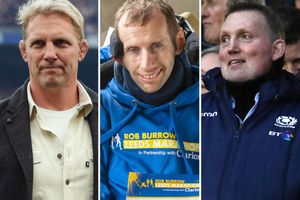 Motor neurone disease explained: What is it? How does it affect people? What links are there to sport and why is there hope?
 PSG vs Arsenal: The dismantling of Bayern Munich by French champions is a Champions League final warning for Mikel Arteta