

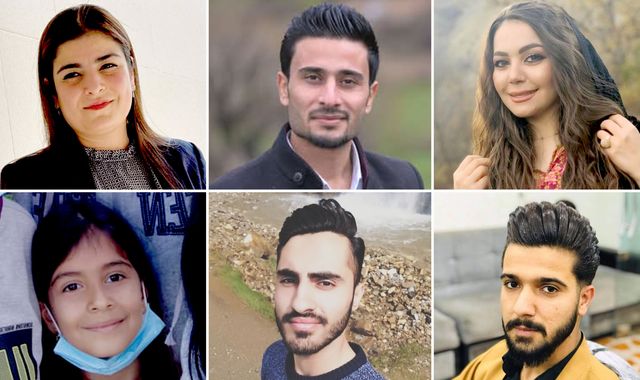
The lives of more than 30 people who died trying to cross the Channel in a small boat could have been saved had a French warship responded to a Mayday call, an inquiry has found.
Chairman Sir Ross Cranston also said the people smugglers who supplied the unsafe inflatable vessel, and flaws in HM Coastguard's search and rescue response, contributed to the deadliest incident of its kind on record.
The boat became swamped and capsized while attempting the journey from France to the UK in the early hours of 24 November 2021.
A four-week public inquiry - costing around £7.5m - identified 27 men, women and children, whose bodies were recovered, while four other people are missing and presumed dead.
Only two of at least 33 people who boarded the boat survived after they were recovered in French waters nearly 12 hours after the first calls for help.
In his 454-page report, Sir Ross concluded the loss of life "was avoidable" and "some of the deaths could've been prevented" as he said: "The practice of small boat crossings must end."
He said: "Apart from other reasons, it is imperative to prevent further loss of life.
"Travelling on board a small, unseaworthy and crowded boat, and crossing one of the busiest shipping lanes in the world, is an inherently dangerous activity."
Sir Ross said the people smugglers involved supplied an unsafe vessel with inadequate safety equipment for the crossing, then dangerously overloaded in with at least 33 people.
The inquiry heard Mubin Rizghar Hussein, a 16-year-old Iraqi Kurdish boy, made the first distress call to the UK authorities at around 1.30am, telling the operator: "Everything is finished".
HM Coastguard broadcast a mayday message at 2.27am, when the closest vessel was the French warship Flamant, which was being used by the French Coastguard, about 15 minutes away.
The reasons why Flamant did not respond to what was called "incident Charlie" are subject to a French criminal investigation, so the report states the impact remains "uncertain".
"However, given its proximity to incident Charlie at the time of the Mayday relay, and that the small boat was intact at this time, if the Flamant had attended incident Charlie, many more and possibly all lives would have been saved," it said.
Sir Ross also said "systematic failures, missed opportunities and inadequate resourcing" undermined the UK's search and rescue response.
HM Coastguard was placed in an "intolerable position", with "chronic staff shortages" and "staff overwhelmed" at Dover, and other deficiencies, "contributing directly to the failure to rescue people in the water," the report said.
Government failure
The issues had been known about for some time, but no action had been taken, representing a "significant, systemic failure on the part of government", which was then led by then prime minister Boris Johnson, it said.
A total of 367 people were rescued by Border Force in the Channel that night, while 757 people arrived in the UK after crossing by small boat on November 24.
Read more from Sky News:
Family of woman who died in Cape Verde issue warning
Sky News reporter goes undercover in scam centre
A Border Force cutter boat, Valiant, had left at 2.22am to get to the last location of the boat, but did not find it, which the report said was "not attributable to the captain or crew".
The search was terminated after one of another three small boats was recorded as incident Charlie, and a helicopter also returned to base.
Sir Ross said a widely held belief that callers from small boats "exaggerated their level of distress" impacted "negatively" on the search and rescue response.
This meant after the last call was made at 3.11am, the search coordinator didn't give "any serious consideration" to the alternative scenario that those on board had fully entered the water, the inquiry found.
'Treated like an animal'
One of the two survivors, Issa Mohamed Omar, from Somalia, told the inquiry he was holding on to what remained of the boat all night, with around 10 people still alive as the sun rose, and could hear a mother screaming as she searched for her children.
"I believe if rescue would come quickly I believe half of those would still be alive today," he said.
"Because we have been seen as refugees, that's the reason the rescue did not come at all. We feel like we're treated like an animal."
A French fishing boat found the first bodies floating in the 13C water at around 12.30pm, the inquiry heard.
The inquiry concluded: "If a search for survivors had been adequately undertaken during 24 November, including daylight hours, more lives would've been saved."
Sir Ross said much has improved since the incident but has made a series of 18 recommendations relating to the search and rescue for small boats and more generally.

(c) Sky News 2026: Loss of life was 'avoidable' in deadliest ever Channel migrant boat sinking, inquiry finds
 UKHSA investigating 36 cases of children falling ill linked to recalled batches of baby formula
 Family of woman who died after Cape Verde holiday issue warning - as spike in illnesses revealed
 Relationship with United States is 'rock solid', Taiwan president insists - despite Donald Trump's call with Xi Jinping
 Savannah Guthrie makes emotional plea to mother's captors: 'We are ready to talk'