

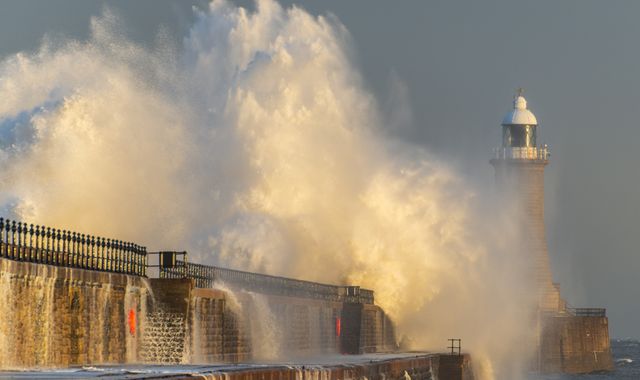
Storm names for the year ahead are released by the Met Office every September after input from the public.
More than 40,000 suggestions were put forward, including names in honour of a young weather enthusiast, a much-loved Labrador puppy and Shaun the Sheep from a popular animation.
Austen, Boelo and Chloe will be the first named storms of this winter.
Chloe was selected by the Met Office after being put forward more than 120 times, including by the mother of a five-year-old who is "fascinated by the weather" - but can also "create a storm by herself" when she is tired.
The name Finn was suggested for a two-year-old boy described by his family as "wild and a force to be reckoned with", while Ivy was nominated in honour of a nine-month-old Labrador puppy affectionately known as "the absolute destructor".
Shaun also joined the list following a public vote that was run as part of a collaboration with the British animation studio Aardman, which was behind the beloved show Wallace and Gromit.
The new list covers the 12-month period between now and the end of August 2027.
List of 2026/27 storm names
• Austen (Ireland)
• Boelo (Netherlands)
• Chloe (UK)
• Dano (Netherlands)
• Evelyn (Ireland)
• Finn (UK)
• Gwendolyn (Netherlands)
• Heather (Ireland)
• Ivy (UK)
• Jade (Netherlands)
• Kilian (Ireland)
• Laoise (Ireland)
• Miriam (Ireland)
• Nicola (UK)
• Olaf (Netherlands)
• Phelim (Ireland)
• Ruban (UK)
• Shaun (UK)
• Theo (UK)
• Vesna (Netherlands)
• Wende (Netherlands)
How are storms named?
The names are selected by the Met Office, the UK's national meteorological service, in partnership with Ireland's meteorological service, Met Eireann, and Dutch national weather forecasting service KNMI.
They make up the western storm naming group, and have been naming storms since 2015.
The list runs from early September until the following August, to coincide with the start of autumn. It is around this time that the potential for storms severe enough to be named increases.
Names run alphabetically, with the letters Q, U, X, Y and Z missed out to keep in line with the US National Hurricane Centre naming conventions.
The Met Office says several factors are considered before a name makes it to the list, including:
• How difficult it might be to pronounce;
• If it has different meanings across the different countries;
• If it is connected to a significant public figure;
• If it could be considered to be controversial in some way.
Storms are given a name when they are deemed to have the potential to cause medium or high impacts in the UK, Ireland or the Netherlands.
The impact of strong winds is the primary factor considered, but additional issues from rain or snow are also looked at.
Why are they given names?
Storms are assigned names throughout the year to help make them easily identifiable for those affected by them.
The Met Office says it means there is consistency in messages through the media and the government, making the public better placed to protect themselves, their property and businesses.
Read more from Sky News:
Man charged with murder over fatal house fire
Body of woman in park was inside bin bag
Holly Clements, Met Office head of warnings and guidance, said: "For more than a decade, storm naming has helped us communicate the risks from severe weather more effectively.
"A named storm provides a clear focus for forecasts and warnings, helping more people understand the potential impacts and take action to protect themselves, their families and their property."
In the last year, four names were used from the list, reaching the letter D with Storm Dave in April 1, although the UK was also hit by three further storms named by other European meteorological services - Storms Benjamin, Claudia and Goretti.
Is it the same around the world?
Many other countries work together to name their storms for consistency.
Similar to the western storm naming group, Spain, Portugal, France, Belgium and Luxembourg together make up the south-western storm naming group, while Norway, Sweden and Denmark are the northern group.
Further afield, tropical or subtropical cyclones in the North Atlantic Ocean are named by the National Hurricane Centre, while the World Meteorological Organisation has six alphabetical lists of names which are used on a six-year cycle.
In order to avoid confusion, the names of tropical storms, hurricanes or cyclones that travel across the Atlantic towards the UK, are not changed.

(c) Sky News 2026: How are storm names chosen and why?
 Man accused of murder over fatal house fire near Middlesbrough appears in court
 Retail giants including M&S and Tesco warn PM over budget tax raid
 First baby identified through Scotland's SMA screening programme starts treatment
 At least two dead and 80 rescued after flash flood hits Grand Canyon