

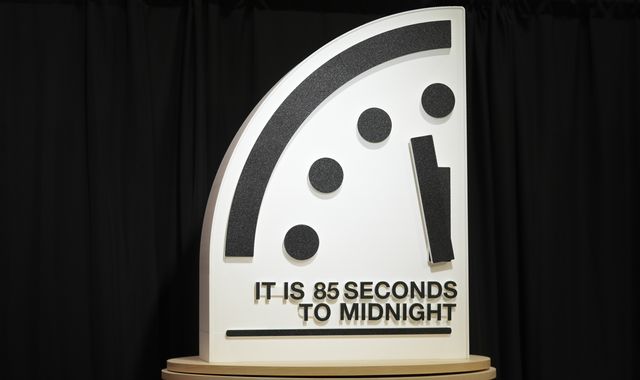
The Doomsday Clock has been moved closer than ever to midnight by scientists, a change that is said to signify that we are edging closer to the end of the world.
The clock, which is a metaphor for the dangers facing humanity, is updated based on perceptions about how close humans are to destroying the world - with midnight symbolising that point.
The current time has been moved to 85 seconds to midnight, down from 89, which was the previous record for the closest time to midnight.
"Every second counts, and we are running out of time. It is a hard truth, but this is our reality. It is now 85 seconds to midnight," said Alexandra Bell, CEO of the Bulletin of the Atomic Scientists, which sets the time.
So why have scientists changed the time, and what does it actually mean?
Nuclear threats, war and AI among driving factors
Nuclear concerns were top of the list for the scientists, who cited aggressive behaviour by nuclear powers Russia, China and the US.
"In terms of nuclear risks, nothing in 2025 trended in the right direction," Ms Bell said.
"Longstanding diplomatic frameworks are under duress or collapsing, the threat of explosive nuclear testing has returned, proliferation concerns are growing, and there were three military operations taking place under the shadow of nuclear weapons and the associated escalatory threat.
"The risk of nuclear use is unsustainably and unacceptably high."
The last nuclear arms pact between the US and Russia, which caps both countries' number of deployed nuclear warheads at 1,550, expires on 5 February.
Russia's president Vladimir Putin proposed in September to extend it for another year, but US president Donald Trump has not formally responded, as Western security analysts are divided about whether it would be the right move.
Scientists said that generally, danger was being driven by Russia, China, the US and other countries becoming "increasingly aggressive, adversarial, and nationalistic".
"Of course, the Doomsday Clock is about global risks, and what we have seen is a global failure in leadership," said Ms Bell.
She also pointed to Russia's continued war in Ukraine, the US and Israeli bombing of Iran and border clashes between India and Pakistan.
Ms Bell went on to cite continuing tensions in Asia including on the Korean peninsula and China's threats toward Taiwan, as well as rising tensions in the Western Hemisphere since Mr Trump's second term began a year ago.
The scientists also voiced concern about threats of unregulated integration of AI into military systems and its potential misuse in aiding the creation of biological threats, as well as its role in spreading disinformation globally.
Maria Ressa, 2021 Nobel Peace Prize winner, participated in the announcement.
"We are living through an information Armageddon - the crisis beneath all crises - driven by extractive and predatory technology that spreads lies faster than facts and profits from our division," she said.
How did we get so close to midnight?
In 2020, scientists moved the hands of the clock forward to 100 seconds to midnight after the breakout of COVID-19.
It stayed at 100 seconds for three years, until it was moved forward to 90 seconds in 2023.
The scientists said it was due to the "mounting dangers of the war in Ukraine and the increase in nuclear threat, political tensions, climate change and illnesses, which made 2023 a "time of unprecedented danger".
It stayed the same upon review the following year, when scientists said there was a "continuing unprecedented level of risk" from threats including war, the climate crisis and the "dramatic advance" of AI.
Last year, the scientists said the shift from 90 to 89 seconds to midnight should serve as "a warning to all world leaders".
This year, they said the warning had been ignored.
Why does the clock exist?
The countdown is agreed on by experts at the Bulletin of the Atomic Scientists, founded in 1945 by scientists including Albert Einstein and J. Robert Oppenheimer.
After the US dropped atomic bombs on Hiroshima and Nagasaki at the end of the Second World War, members of the Bulletin saw a need to help the public understand the scale of the nuclear threat to the existence of humanity.
Artist Martyl Langsdorf came up with the idea of the clock to symbolise the dangers of nuclear confrontation.
Its first iteration was on the front cover of the Bulletin's magazine in 1947, when scientists agreed the time was seven minutes to midnight.
The clock moves closer to or further away from midnight based on how the experts on the board, plus academic colleagues and the Bulletin's sponsors - which include 13 Nobel laureates - read the threats facing the world.
It has been ticking away as political, nuclear and climate changes continued over the years, with experts revising the time up and down - mostly closer to midnight and its metaphor for total disaster.
There have been more reassuring years in the past. In 1995 the clock was at 14 minutes to midnight, the safest reading in its history.
And there were "positive strides" in some years, such as the Paris climate agreement.
Ever since 1998, however, the hands of the clock have been at less than 10 minutes to midnight.

(c) Sky News 2026: Doomsday Clock moved closer to midnight than ever: What is it and how does it work?
 Hundreds of jobs lost as Revolution bars owner enters administration
 Rabbi Pinchas Goldschmidt says Europe must do 'much more' to support revolution in Iran
 Boy, 14, charged over fatal e-scooter crash in Manchester
 Pubs and music venues to be handed business rates relief after government U-turn