


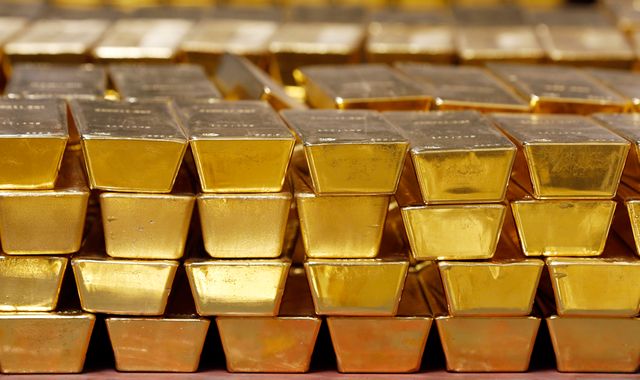
Gold and silver costs are taking further punishment on Monday following record routs seen at the end of last week.
Both precious metals had stood at record values on Thursday but fell sharply after Donald Trump revealed his nomination for the chair of the US central bank.
The announcement on Friday that he wanted Kevin Warsh to succeed Jay Powell from May calmed market nerves over Federal Reserve independence.
Money latest: MP shares secrets of the job
This was seen to the greatest extent in so-called safe haven gold and silver prices, which suffered their worst day since 1983 and 1980 respectively by the US close on Friday night.
The declines continued on Monday with spot gold down by a further 7%. Silver was almost 11% down after its 30% fall in the previous session.
Market analysts said this was partly due to the fact that some brokerages were increasing their margin requirements - raising the minimum amount of money investors must deposit to open or maintain leveraged positions.
Such a move during a period of volatility is generally negative for an investor's contracts and some were having to sell other assets to cover higher gold and silver margin calls.
Gold stood at $4,480 per ounce and silver at $73.94 early on Monday morning.
Each had reached record highs of $5,594.82 and $121.64 respectively during the rally that preceded the sell-off.
Also doing badly since Friday have been cryptocurrencies.
Bitcoin dropped below $80,000 for the first time since April during the weekend and stood at $75,142.
Brent crude oil, which was trading at $70 a barrel last week, was at $65.
The hits were reflected in stock market values in Europe after sharp declines in Asia, where the Hang Seng in Hong Kong closed the day 2.3% down.
The FTSE 100 - home to many precious metal mining and energy stocks - was 0.5% down in early dealing.
US futures showed a decline of around 1% loomed for the broad-based S&P 500.
Ipek Ozkardeskaya, senior analyst at Swissquote, said many of the market shifts were being driven by the known views of Mr Warsh, including his past criticism of Fed policy decisions.
"He is expected to favour balance sheet reduction for bringing inflation down. And there is scope to shrink the Fed's balance sheet substantially!
"Before 2008, the balance sheet stood below $1 trillion, peaked near $9 trillion in 2022, and now sits around $6.5 trillion.
"That could mark the end of the era of free money for markets - and that is bad news", she wrote in a note.

(c) Sky News 2026: Gold and silver take a hammering in major market shifts
 Former TikTok employee accuses company of bullying, harassment and union busting
 Thames Water closes in on £16bn rescue deal with lenders
 Ex-RFU chair Ilube provides missing LINK for ATM network
 Why you should think twice before using common payment method | Money newsletter